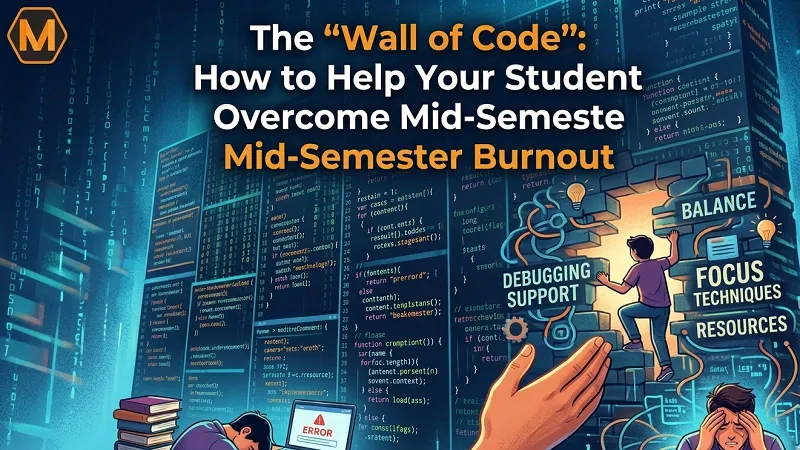
The mid-semester slump is a well-known phenomenon in traditional subjects, but for students diving into the world of computer science, it often hits differently. We call it the “Wall of Code.” It is that specific moment where the initial excitement of building a website or a simple game vanishes, replaced by a mountain of complex logic, nested loops, and cryptic error messages that seem to have no solution. For a student, hitting this wall isn’t just about being tired; it’s about the mental exhaustion that comes from staring at a screen for six hours only to realize a single misplaced semicolon was the culprit. As a parent, watching your child grow increasingly frustrated with their monitor can be heartbreaking, especially when the “logic” of programming feels like a foreign language to the rest of the household.
Understanding the weight of these technical hurdles is the first step toward providing real support. When the pressure to perform becomes overwhelming, some students may look for ways to pay for programming assignment tasks to manage their heavy workload, and in these moments, having a reliable resource such as my assignment help can provide the structural guidance needed to turn a failing project into a learning opportunity. The goal isn’t just to get the work done, but to prevent the total burnout that leads many bright students to quit STEM fields altogether. By recognizing the signs of academic fatigue early, such as irritability, late-night “doom-scrolling” through forums, or a sudden drop in coding productivity, you can intervene before the “Wall of Code” becomes a permanent barrier to their future career.
Why Programming Burnout is Different
In most subjects, if you study for three hours, you usually see three hours’ worth of progress. In programming, you can study for ten hours and end up with a program that still won’t run. This “nonlinear” progress is the primary cause of student burnout. The brain is forced to maintain a high level of “cognitive load,” holding multiple variables and logical paths in memory at once. When that memory bank gets full, the “Wall” appears.
| Stage of Burnout | Student Behavior | Impact on Coding Quality |
| Stage 1: The Grind | Staying up late, skipping meals to “just finish this one function.” | Messy code, lack of comments, and ignoring best practices. |
| Stage 2: The Fog | Staring at the screen without typing, feeling “stuck” on simple logic. | Increase in syntax errors and logical loops. |
| Stage 3: The Wall | Extreme irritability, avoiding the computer entirely, feeling of “imposter syndrome.” | Complete work stoppage; inability to debug even basic scripts. |
The Silent Struggle with Specialized Languages
Every programming language comes with its own set of “personality traits” and frustrations. While a student might excel in the visual logic of one language, they might find the strict requirements of another completely demoralizing. Python, for instance, is often praised for its readability, yet its strict indentation and specific library requirements can still lead to hours of troubleshooting for a tired mind.
If your student is currently grappling with data science or automation scripts, they might specifically find themselves in need of Python assignment help to understand how to properly structure their back-end logic. This is where the transition from “learning to code” to “computer science” becomes difficult. The student is no longer just typing commands; they are managing data flow and memory, which requires a rested, sharp mind.
The Anatomy of the “Wall of Code”
To better support a student, it helps to understand what is actually happening inside their workflow. Most coding projects follow a predictable lifecycle, and burnout most often appears during the debugging phase, which can take up to 90% of a project’s total time.
Requirement Analysis
This is the stage where the student interprets what the assignment is asking for. It involves breaking down instructions and identifying the expected inputs, outputs, and constraints.
Logic Planning
At this stage, the student designs the solution before writing any code. This may include flowcharts, pseudocode, or mental mapping of how data should move through the program.
Implementation
This is the execution phase where the actual code is written. Ideas from the planning stage are translated into a working program using the chosen programming language.
Debugging
This is often the most time-consuming and mentally demanding phase. It involves identifying why the implemented code does not behave as expected. Since debugging requires constant comparison between logic and reality, it is where most frustration and burnout tend to occur.
Practical Strategies to Break the Burnout Cycle
To help your student scale the “Wall of Code,” a combination of lifestyle adjustments and academic strategies is often most effective. Here are four practical ways to help them reset and regain momentum:
The Rubber Duck Method
This is a well-known industry technique. Encourage your student to explain their code step by step—either to you or even to a literal rubber duck. By translating code into plain English, the brain is forced to identify logical gaps that are often overlooked when only reading or writing code on a screen.
The 20-20-20 Rule
To reduce physical and mental fatigue, they should follow the 20-20-20 rule: every 20 minutes, look at something 20 feet away for at least 20 seconds. This helps reduce “Computer Vision Syndrome,” which can contribute to eye strain, headaches, and overall cognitive burnout.
Refactoring the Schedule
Sometimes the “wall” is not just academic, it’s structural. A cluttered or unrealistic schedule can make even simple tasks feel overwhelming. Breaking work into micro-sprints can help. Instead of setting a goal like “finish the project,” focus on smaller targets such as “fix the login loop” or “debug one function.”
Normalize External Assistance
In real-world development, using documentation, tutorials, and peer reviews is standard practice. Learning how to seek help is not a weakness; it is a professional skill. External resources should be viewed as tools for learning better coding patterns, not as a sign of giving up.
Understanding the Mid-Semester “Technical Debt”
In the middle of a semester, assignments become increasingly cumulative. If a student struggled with classes in week four, they are likely to find inheritance in week eight extremely difficult. This is known as technical debt, the accumulation of misunderstood concepts that, over time, can cause larger projects to break down or feel unmanageable.
Parents can help by encouraging a “Back-to-Basics” day. If a student is stuck on a complex Python script, suggest they step back and first write a very simple version of the program. Removing unnecessary complexity helps isolate the core issue and makes it easier to identify where understanding is breaking down.
Creating a Sustainable Tech Environment at Home
The physical space where a student codes can significantly influence their stress levels, focus, and long-term productivity. High-performance learning often depends on a supportive and well-structured environment.
The Dual Monitor Advantage
If possible, providing a second screen can make a noticeable difference. One screen can display instructions, tutorials, or documentation, while the other is used for the code editor. This setup reduces “Alt-Tab fatigue,” where frequent switching between windows interrupts focus and breaks concentration during problem-solving.
Blue Light Management
Using “Night Mode” or blue light reduction tools in the evening can help reduce eye strain and support healthier sleep patterns. Excessive blue light exposure late at night can interfere with melatonin production, making it harder for the brain to wind down and recover properly after long coding sessions.
Ergonomics
Physical comfort plays a major role in sustained focus. A student coding on a laptop in a hunched position may experience physical fatigue long before mental fatigue sets in. A basic ergonomic setup, such as a proper desk, external keyboard, and mouse, can significantly extend their ability to engage in deep, uninterrupted work.
The Role of Resilience in Technology
The most important lesson a student can learn during the mid-semester crunch isn’t a specific coding language; it’s resilience. In the professional tech world, things break every day. Senior developers spend more time fixing errors than writing new code.
By helping your student navigate the “Wall of Code” now, you are preparing them for a career where problem-solving is the primary currency. Remind them that every frustrating error message is actually an invitation to learn something new. When they finally see that “Process finished with exit code 0” (meaning it worked!), the sense of accomplishment will be worth the struggle.
When to Seek Extra Help
There is a fine line between “healthy struggling” and “hopeless drowning.” If your student is no longer eating or sleeping, or if their self-esteem is tied entirely to the success of a single script, it is time to look for outside help. Whether it’s a tutor, a peer study group, or a specialized academic service, getting a second pair of eyes on a project can provide the “aha!” moment that clears the fog of burnout.
Providing your student with the tools to succeed both mentally and academically ensures that they don’t just finish the semester, but that they do so with their passion for technology intact. The “Wall of Code” is high, but with the right support, it is far from insurmountable.
Summary Checklist for Parents
- Listen: Allow them to talk through their “bugs” and frustrations without immediately trying to fix the code. Sometimes they need to verbalize the problem before they can solve it themselves.
- Observe: Pay attention to changes in sleep patterns, mood, or stress levels. These shifts can signal more than just a busy academic week and may indicate growing burnout.
- Encourage: Remind them that every skilled programmer started with the same fundamentals they are learning now. Progress in coding is built through repetition, mistakes, and gradual understanding.
- Resource: Make sure they understand that seeking academic support, such as tutoring, office hours, or study groups, is a strategic learning decision, not a weakness.
By maintaining open communication and a supportive home environment, parents can help students navigate the challenges of programming education while prioritizing their mental well-being. Success in the digital age is a long-term process, not a quick sprint, and consistent support often plays a key role in helping students stay on track and reach their goals.
Frequently Asked Questions
How can I tell if my child is experiencing academic burnout?
Watch for signs like persistent irritability, a sudden loss of interest in their projects, or physical exhaustion. If a student is spending hours staring at a screen without making progress or becomes unusually anxious about minor errors, they may have hit a mental wall that requires a break.
What is the best way to support a student who is stuck on a difficult task?
Encourage them to step away from the desk for a short period to reset their focus. Sometimes, simply having them explain the logic of their work to you in plain English can help them identify their own mistakes and clear the mental fog.
How many hours should a student spend on complex projects each day?
While workloads vary, quality is more important than quantity. It is highly recommended to follow a structured routine, such as working in 50-minute blocks with 10-minute breaks, to maintain high cognitive performance and prevent long-term fatigue.
Can changing the study environment really improve productivity?
Yes. A dedicated workspace with proper lighting and ergonomic support reduces physical strain, which in turn lowers mental stress. Reducing digital distractions and using a larger screen can also help the brain process complex information more efficiently.
About The Author
Ella Thompson is a senior content strategist at myassignmenthelp, where she specializes in bridging the gap between complex academic requirements and student productivity. With a focus on clear communication and educational growth, she develops resources that help learners navigate their academic journeys with confidence.